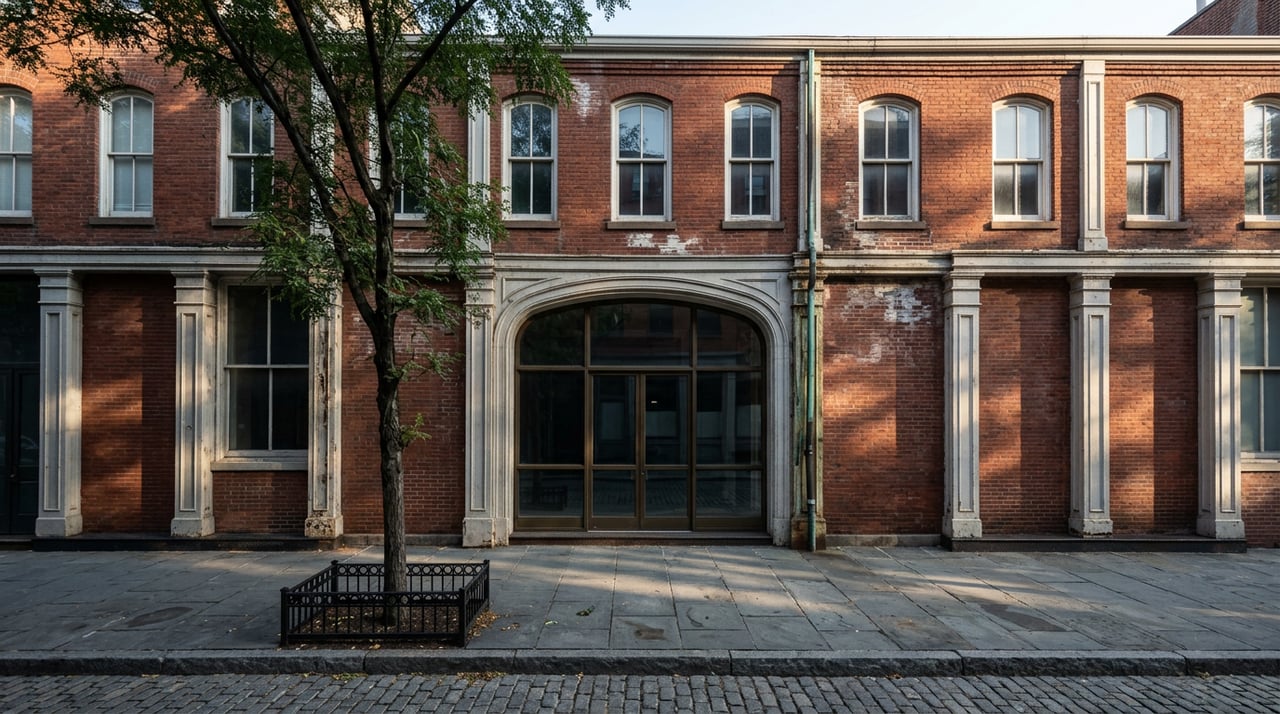
Everyone who has lived in SoHo long enough knows the story: the artists came for cheap cast-iron lofts in the 1960s and 70s, the galleries followed, and by the mid-1990s most of those galleries had packed up for Chelsea's larger, cheaper floor plates. What's left, the story goes, is the shell. Cobblestones, arched windows, a Bloomingdale's, and the memory of a scene that moved on decades ago.
Walk Wooster and Greene Street this week and that story stops holding up. Eight galleries and one museum have shows opening or already running right now, most of them within a ten-minute walk of each other, most of them announced in the same first two weeks of September. This isn't a nostalgia act. It's a calendar.
The Exodus Everyone Remembers
The broad outline is accurate. SoHo's cast-iron buildings were originally zoned for manufacturing, and when factories left the city starting in the 1950s, artists moved into the empty lofts because the space and light were unmatched anywhere else in Manhattan. Galleries followed the artists. By the 1990s, most of the major commercial names had relocated north to Chelsea, chasing bigger rooms and lower rents. What stayed behind was the architecture: the largest concentration of cast-iron facades anywhere in the world, still protected under the SoHo-Cast Iron Historic District.
For thirty years, that's been the whole story people tell about SoHo's relationship to art. It's a fair summary of 1996. It's a poor summary of September 2026.
What Actually Opened This Month
Here's the part that doesn't show up in the old narrative. A cluster of galleries, some long-established in the neighborhood and some newly arrived, opened new shows within days of each other this month, almost all of them one street off the tourist spine of Broadway.
| Gallery | Address | Show | Dates |
|---|---|---|---|
| Hauser & Wirth | 134 Wooster St | Rita Ackermann, The Chemical Alphabet | Sept 9 – Oct 17 |
| Jeffrey Deitch | 18 Wooster St | Eddie Rodolfo Aparicio, Rubberneckers | Sept 12 – Oct 31 |
| Jeffrey Deitch | 76 Grand St | Celeste Dupuy-Spencer, Burning in the Eyes of the Maker | Sept 12 – Oct 31 |
| Nicodim | 15 Greene St | Tomas Harker | Sept 10 – Oct 3 |
| Mier Gallery | 62 Crosby St | José Lerma, Thespesia Grandiflora | Sept 9 – Oct 17 |
| Mier Gallery | 380 Broadway | Christopher Astley, Umwelt | Sept 11 – Oct 17 |
| Kaufmann Repetto | 55 Walker St | Gökhun Baltacı | Sept 9 – Oct 31 |
| Norr Cohan | 48 Walker St | Savdie / Soutine | Sept 10 – Oct 24 |
| Norr Cohan | 52 Walker St | Vicky Colombet, Memory of the Surface | Sept 17 – Oct 24 |
| Nowhere | 40 Lispenard St | exonemo, TERMINAL | Sept 10 – Nov 7 |
| HB381 | 381 Broadway | Marianne Huotari | Sept 10 – Oct 31 |
Read that list as geography rather than as a program note and a pattern shows up. All eleven of these shows opened within the same eight-day span, September 9 through September 17. That's not a coincidence of the art-world calendar. Galleries time their fall openings to land after Labor Day and before the November auction cycle, and this year that meant a genuine cluster, not a trickle, hit SoHo's side streets at once.
The geography matters too. None of this is happening on Broadway or West Broadway, the blocks most visitors picture when they picture SoHo. It's happening on Wooster, Greene, Crosby, Walker, and Lispenard, the quieter grid one to two blocks west, in exactly the kind of ground-floor industrial spaces that made the neighborhood an artists' colony in the first place. Hauser & Wirth's Wooster Street space and Jeffrey Deitch's two rooms sit inside that older cast-iron core. The Walker Street cluster, Kaufmann Repetto and Norr Cohan's two spaces, sits closer to the Tribeca border, in a stretch that barely registered as a gallery block a decade ago.
The Museum Show With a Deadline
Not everything on this list has weeks to spare. The Leslie-Lohman Museum of Art, at 26 Wooster Street, the first accredited museum in the country dedicated to queer art, is closing Rocío García's exhibition The Object of Power is Power on September 20. That's a week from today. It's free to enter, and it's the kind of show that a resident who walks past the building every day can put off indefinitely and then miss entirely.
The Free Room Two Doors Down
A few storefronts north on the same street, the Drawing Center at 35 Wooster is running a smaller, quieter show through September 27: the Black Art Library, a rotating selection of books by and about Black artists drawn from Detroit's Black Art Library, open for anyone to sit with from noon to 6 p.m. There's no admission fee and no reservation. It's the kind of thing that only works if someone tells you it's there before the last week it's up.
The Retail Footnote That Closes the Same Week
One block east, past the gallery cluster and just shy of SoHo's edge on Mott Street, Left on Friday has a seasonal pop-up running through the same date, September 27. The Canadian swimwear brand treats its summer pop-ups as a deliberate retail strategy, doubling its physical footprint for the peak selling months without committing to a year-round lease, and its SoHo location has become the New York stop in that rotation. It's a small detail on its own. Next to a museum show and a free reading room both closing the same week, it starts to look like the whole neighborhood is quietly synced to the same clock this month, even when the businesses involved have nothing to do with each other.
A Walk That Fits Before the Month Turns
If you're only doing this once, here's a route that covers most of it without backtracking. Start at Hauser & Wirth on Wooster near Houston for the Ackermann show, then walk two doors down to the Drawing Center for the Black Art Library, and a few more storefronts to Leslie-Lohman before the García show closes. Cut over to Grand Street for Jeffrey Deitch's second space, then back up to Greene for Nicodim. From there it's a short walk to Crosby for Mier Gallery's two-artist split between Crosby and Broadway. Head south into the Walker Street cluster, Kaufmann Repetto and Norr Cohan's two rooms sit almost across from each other, then finish at HB381 on Broadway near White. If you have one more stop in you, Left on Friday on Mott is close enough to fold in on the way home.
None of this requires a car, a reservation, or a weekend set aside. Most of these blocks sit within a half-mile of each other, which is part of what made SoHo's original gallery scene possible in the first place: the density that let one bad afternoon turn into five good shows.
What This Actually Says About the Neighborhood
The point isn't that SoHo has become Chelsea again. It hasn't, and the scale is different by design. What this month shows is that the neighborhood's identity as a place where serious art happens on the ground floor of a converted loft never fully closed, it just went quiet for a couple of decades while galleries the size of Hauser & Wirth and Jeffrey Deitch tested other footprints first. When they came back, they came back to the same cast-iron shells the artists occupied sixty years ago, on the same side streets, at the same street level.
For anyone who already lives here, that's the useful fact. Not that SoHo is trendy again, but that the specific texture that made the neighborhood worth living in, walkable density, ground-floor culture, a scene you can see on your way to buy coffee, is doing something real this month rather than being something you explain to visitors as a thing that used to happen.
If you're the kind of resident who keeps a running list of what's worth walking to, or if you're weighing what a neighborhood like this actually offers day to day before making a move within it, Ava Anz tracks this kind of detail across SoHo and the surrounding downtown blocks as a matter of course. Reach out anytime you want a second opinion on what a particular block, building, or season in this neighborhood is really like to live in.


